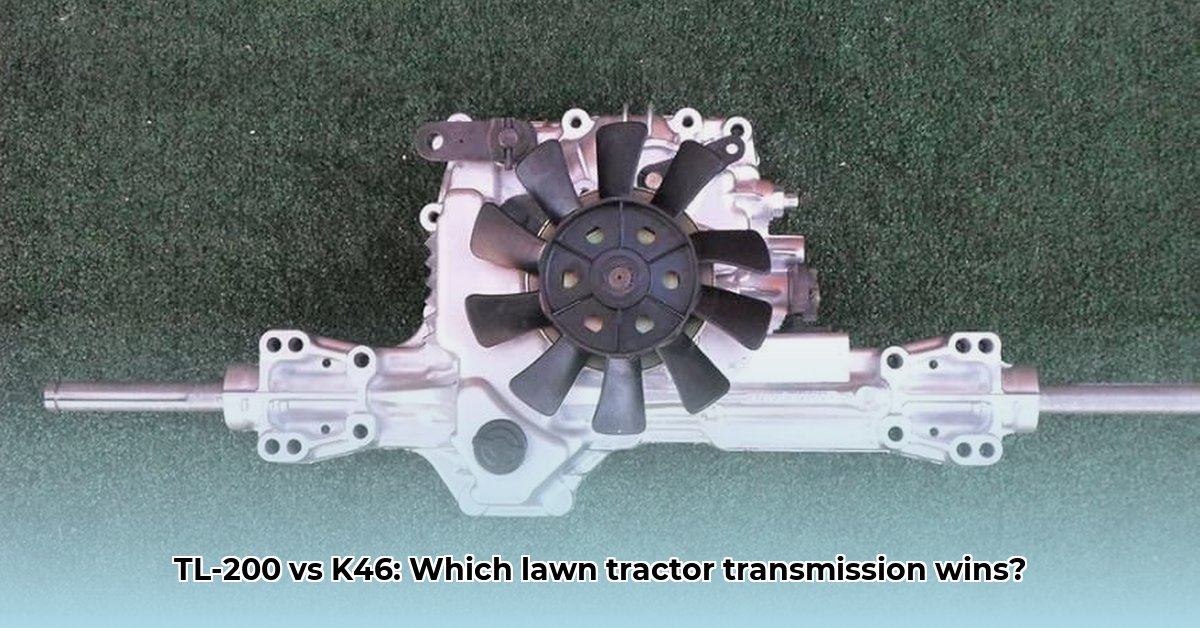
Choosing the right transmission for your lawn tractor significantly impacts its performance, longevity, and your overall mowing experience. This comparative review analyzes two popular options: the Tuff Torq TL-200 and the Hydro-Gear K46, helping you make an informed decision. For more on choosing the right tractor, see this helpful guide: tractor types.
Tuff Torq TL-200 vs. Hydro-Gear K46: A Detailed Comparison
Both the TL-200 and K46 are hydrostatic transmissions offering variable speeds (typically 0-7 mph) and suitable for engines up to approximately 20 horsepower—common in residential lawn tractors. Both also include automatic differential locks for enhanced traction on uneven terrain. However, key differences in durability, maintenance, and cost significantly impact their suitability for varying needs.
Performance and Durability: The Workhorse vs. the Value Option
The TL-200 is built for durability. Its heavier-duty construction, featuring larger bearings, stronger gears, and an improved cooling system, suggests superior longevity, especially in demanding environments (e.g., hilly terrain). This robust design translates to potentially lower long-term repair costs, despite a higher initial investment. The K46, conversely, represents a more budget-friendly alternative, ideal for smaller yards and less strenuous use. Its lighter-duty components keep the price down but may compromise longevity under intense or frequent use.
Rhetorical Question: Considering the potential for long-term cost savings, isn't investing in a more durable transmission a worthwhile consideration for homeowners with challenging landscapes?
Quantifiable Fact: The TL-200 boasts a larger oil capacity (2.1 quarts vs. 2 quarts in the K46), improving lubrication and potentially extending component lifespan.
Maintenance and Serviceability: Ease of Access and Long-Term Care
Regular maintenance (oil changes and filter replacements) is crucial for both transmissions. However, the TL-200 offers significantly easier servicing. Its convenient spin-on oil filter simplifies maintenance, saving time and effort. The K46, depending on the specific model, may require more involved procedures. This difference in serviceability can significantly impact long-term ownership costs and user satisfaction.
Cost Considerations: Balancing Initial Investment with Long-Term Value
The TL-200 commands a higher initial price point than the K46. While this might seem daunting initially, the enhanced durability and ease of maintenance suggest potential long-term cost savings. The K46's lower upfront cost makes it an attractive choice for budget-conscious buyers, but potential repair expenses need to be factored into the total cost of ownership.
Quantifiable Fact: The TL-200 typically weighs 72 lbs, showcasing its robust construction, while the K46 weighs approximately 66 lbs.
Choosing the Right Transmission: Matching Your Needs to the Best Option
The optimal transmission depends entirely on individual priorities and usage patterns.
Choose the Tuff Torq TL-200 if:
- You need a highly durable transmission capable of handling challenging terrain (hills, uneven ground).
- You prioritize ease of maintenance and long-term reliability.
- You are willing to invest initially for potential long-term cost savings.
Choose the Hydro-Gear K46 if:
- You require a more budget-friendly option.
- Your lawn is relatively small and flat, with minimal demanding conditions.
- You are comfortable with slightly more complex maintenance procedures.
Key Differences Summarized:
| Feature | Tuff Torq TL-200 | Hydro-Gear K46 |
|---|---|---|
| Durability | Superior | Good |
| Price | Higher | Lower |
| Serviceability | Easier | More challenging |
| Oil Capacity | 2.1 quarts | 2 quarts |
| Ideal Terrain | Hilly, uneven | Flat, level |
| Best Suited For | Demanding use, larger properties | Lighter use, smaller properties |
By carefully considering your budget, lawn size, terrain, and maintenance preferences, you can confidently choose the transmission that best meets your needs. Remember that while the TL-200 represents a higher initial investment, its potential for longer lifespan and easier maintenance may lead to overall cost savings in the long run.